Reading a Legal News Report Without Overreading It
Reading a legal news report carefully helps you separate a court’s specific action from commentary, predictions, and questions the story leaves unresolved.
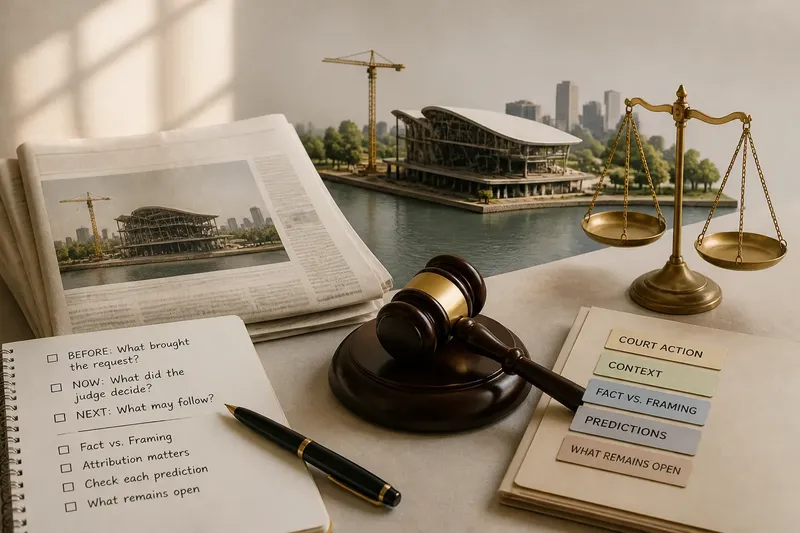
At breakfast, a headline says a judge rejected a request, while the story quotes a lawyer calling the ruling a victory. Reading a legal news report carefully means asking what the court actually did before accepting either description as the whole story.
Imagine a neighborhood association challenges a city permit for a riverside concert venue, arguing that the city failed to consider noise. The association asks a judge to pause construction while the lawsuit proceeds, and the judge denies that request. In this invented situation, the denial settles the request for a pause; by itself, it does not answer whether the permit was lawful or resolve every claim in the lawsuit.
Identify the court action
Find the sentence that says what the court did. It may report that a judge denied a motion, dismissed a claim, issued an order, scheduled a hearing, or asked the parties to address an issue. Those precise verbs are more informative than a headline saying that a “court fight intensifies.”
Then identify the object of the action. A court may deny one motion while leaving other claims untouched. It may dismiss a claim without dismissing the whole case, or issue an order that applies for now without resolving the underlying dispute.
In the imagined venue dispute, the action is a denial of the association’s request for temporary relief. A careful paraphrase would be: “The judge declined to pause construction while the case continues.” That wording does not claim more than the reported action establishes.
Write the court’s action in plain language before considering the headline’s interpretation.
Place the ruling in context
A legal event makes sense in relation to what came before and what may follow. A news report often focuses on one timely development, not because it is the final one, but because it is the event that happened that day.
For the invented association, the report might explain that the city granted the permit before the lawsuit was filed and that the association sought temporary relief while its challenge was pending. Those details explain the request’s setting; they do not establish what a court will decide about the permit later.
- Before: What dispute or request brought the matter to court?
- Now: What did the judge decide or direct?
- Next: What proceeding or decision does the report say may follow?
A scheduled hearing is a calendar event, not a prediction of its result. A party’s plan to file another motion is not an order, and it may not become a filing. Keep reported events distinct from what someone expects to happen.
Separate fact from framing
A legal news report may mix a procedural event, a reporter’s explanation, a party’s interpretation, and a prediction. Classifying each statement helps prevent a quote or allegation from taking on the authority of a court ruling.
In the invented story, “the judge denied the association’s request” describes the reported action. “The ruling is a major victory,” if attributed to the venue’s lawyer, is that lawyer’s characterization. “The case may soon be over” is a forecast unless the report identifies an order or other event that resolves it.
Attribution matters. Phrases such as “the association said,” “the city argued,” and “according to the venue’s lawyer” identify whose position is being described. A party’s allegation should not be silently turned into an established fact. Likewise, a lawyer’s reaction is not the judge’s reasoning.
If a report says the judge found that the association had not met the standard for emergency relief, it presents that as the court’s explanation. If a lawyer says the decision overlooks residents’ concerns, that is a response. Both statements may help explain the dispute, but they are different kinds of claims.
Check each prediction
Words such as “could,” “may,” “likely,” and “signals” often mark uncertainty, even when a headline sounds decisive. Ask what the forecast rests on: a scheduled hearing, a party’s stated intention, a legal analyst’s interpretation, or no identified event at all.
Imagine the association’s lawyer says the lawsuit will continue, while the venue’s lawyer says the ruling should bring the dispute to a close. In this invented situation, those statements describe competing views, not what the judge will do next. Unless the report identifies an order resolving the case, its future remains unsettled.
Keep forecasts separate from developments. If a later report describes a dismissal or an agreement, that new event may change the picture. Until then, a prediction remains a prediction.
What does the report establish?
Does denial of a request end the case?
Not necessarily. A court can deny a request for temporary relief while a lawsuit continues; check whether the report says other claims or proceedings remain.
Is a lawyer’s description the court’s ruling?
No. A lawyer’s description conveys a party’s position or reaction, even beside a report of a judge’s decision. Look for the words that identify who made the statement.
How can I spot uncertainty?
Notice conditional words such as “may” and “could,” and references to planned filings or future hearings. Check whether the story reports an order already made or only an event someone expects.
What if the report omits the order’s details?
Treat the account as limited instead of filling gaps with assumptions. A court order may clarify what was decided; questions about an individual matter call for a qualified legal professional.
Mark what remains open
To see where a story’s account ends, separate what it reports as an event from what remains unresolved. In the imagined venue dispute, the report establishes that the judge declined to pause construction. Unless it says more, it does not establish that the permit was lawful, that the association lost every claim, or that construction will continue without interruption.
- If the report names a denied motion, record which request the judge declined; if it does not name the request, avoid treating the denial as a ruling on the entire case.
- If the story says a claim was dismissed, check whether it also says the whole case ended; if not, leave the status of other claims open.
- If the report describes an order, note whom it addresses and what it directs; if those details are missing, do not assume the order covers every party or issue.
- If the story announces a hearing, record it as a scheduled event; if it predicts the hearing’s result, keep that forecast separate from the calendar item.
- If a lawyer characterizes the decision, attribute the description to that lawyer; if the report provides no attribution, do not present the characterization as the court’s view.
- If the report links to a written order, compare its stated scope with the article’s description; if no order is available, treat the account as a report rather than a complete record.
For a fully worked, invented reading, suppose the report says the judge denied the association’s request to pause construction, quotes the venue’s lawyer calling the decision a victory, and notes a later hearing. First, record the specific action: the pause request was denied. Next, classify “victory” as the lawyer’s view, not the judge’s finding. Then record the hearing as scheduled, without predicting its outcome. The resulting account is narrow but useful: the request was denied, the lawsuit’s merits remain unresolved in the report, and a further proceeding is expected.
A report based on a written order may describe the judge’s reasoning, while one built mainly from interviews may emphasize the parties’ reactions. Check what material the story identifies and, when an order is linked, compare its scope with the report’s summary. The headline may capture the day’s news, but the order or article may set a narrower boundary.
Reading a legal news report carefully leaves room for what remains undecided. The practical question is not merely who seems to have won today, but which specific issue the court answered—and which questions the report leaves open.